
Enjoy Free & Fast Delivery All Pakistan 45 Days Free Returns
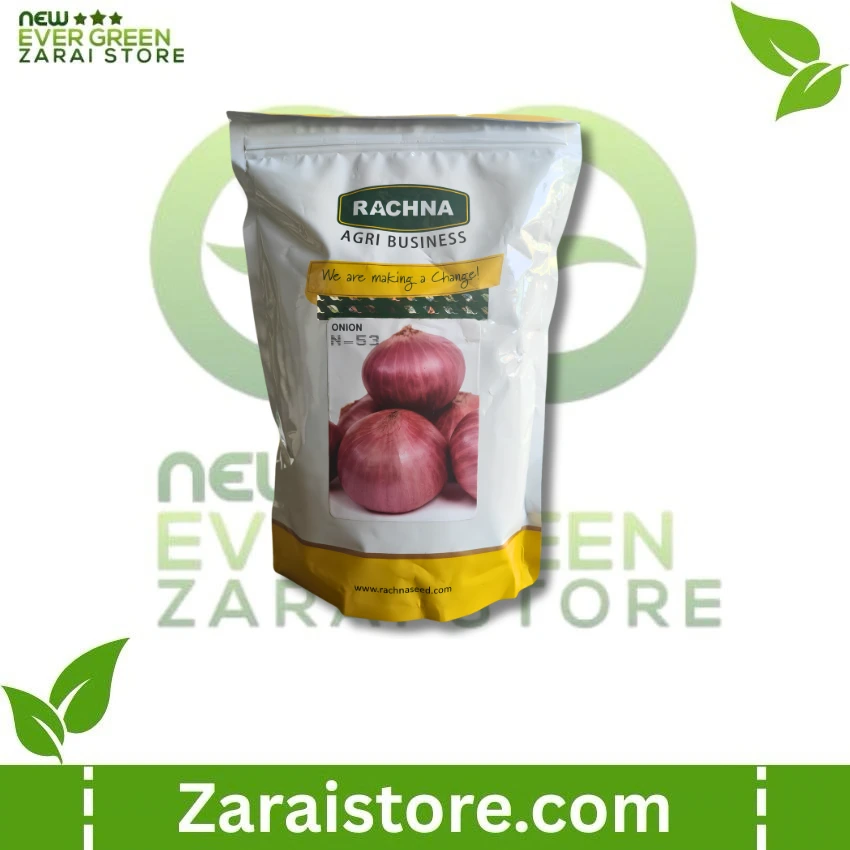
Rachna N-53 Onion Seeds 1kg Pyaz Beej Pakistan (پیازبیج)
Rachna N-53 Onion Seeds 1kg Pyaz Beej
Rachna N-53 Onion Seeds 1kg are intended for onion cultivation and Pyaz production in Pakistan. Suitable nursery preparation, timely transplanting, balanced nutrition, proper irrigation and effective crop management can support healthy plant growth and bulb development. Follow the seed packet instructions and Rachna Agri Business recommendations for variety-specific cultivation guidance.
Delivery Charges in Pakistan: Free (No Charges)
Delivery Charges in Other Countries: Charges will Apply
Rachna N-53 Onion Seeds 1kg by Rachna Agri Business are intended for onion cultivation, commonly known as Pyaz farming in Pakistan. Onion is an important vegetable and commercial crop used in daily cooking, food processing and fresh vegetable markets.
Successful onion cultivation depends on suitable nursery preparation, healthy seedlings, timely transplanting, balanced nutrition, proper irrigation and effective crop management. Farmers should follow the seed packet instructions and company recommendations for variety-specific cultivation guidance.
Rachna N-53 is an onion seed variety supplied by Rachna Agri Business. This product is packed in a 1kg seed packet and intended for growers planning onion production.
Onion cultivation generally begins with nursery preparation, followed by transplanting healthy seedlings into a properly prepared field. Good nursery management and careful transplanting help establish a uniform crop.
Specific information about N-53 maturity, bulb colour, bulb size, storage characteristics and yield potential should be confirmed from the original seed packet or Rachna Agri Business.
| Specification | Details |
|---|---|
| Product Name | Rachna N-53 Onion Seeds |
| Company | Rachna Agri Business |
| Variety | N-53 |
| Crop Name | Onion (Pyaz) |
| Pack Size | 1kg |
| Recommended Seed Rate | 2kg per acre, as provided |
| Package Type | Seed Packet |
| Product Category | Seeds → Vegetable Seeds → Onion Seeds |
| Sowing Method | Nursery Raising and Transplanting |
| Intended Use | Onion cultivation and bulb production |
| Availability | Subject to current stock |
Onion is a bulb-forming vegetable crop belonging to the Allium family. It is cultivated for its edible bulbs and is widely used in Pakistani households and commercial food markets.
Rachna N-53 is the variety listed for this product by Rachna Agri Business. Farmers should check the original packet for official information about bulb characteristics, maturity duration, recommended planting season and other variety-specific features.
Onion generally performs well under suitable seasonal temperatures, fertile and well-drained soil, adequate sunlight and balanced nutrition.
Healthy seedlings, proper transplanting depth, suitable spacing and consistent soil moisture support crop establishment and bulb development.
Rachna N-53 Onion Seeds.
Company: Rachna Agri Business.
N-53 onion variety.
1kg seed packet.
Listed seed rate: 2kg per acre.
Suitable for Pyaz cultivation.
Intended for onion bulb production.
Suitable for farmers and commercial vegetable growers.
Nursery-based cultivation and transplanting method.
Onion is an important vegetable crop with regular household and commercial market demand. Proper crop management can support healthy bulb development and marketable production.
Raising seedlings in a nursery allows growers to manage early plant development before transplanting into the main field.
Onion can be cultivated for local vegetable markets, wholesale supply and commercial production where suitable growing conditions and market planning are available.
Farmers can plan nursery sowing, field preparation, transplanting and harvesting according to local climate and company recommendations.
Actual yield, bulb size, maturity and market quality depend on seed performance, weather, soil conditions and crop management.
Farmers planning commercial onion cultivation.
Vegetable growers producing Pyaz for fresh markets.
Farmers with suitable nursery facilities.
Growers planning seasonal onion production.
Agricultural businesses involved in onion supply.
Farmers following Rachna Agri Business cultivation recommendations.
The following is a general planning guide for onion cultivation in Pakistan. It is not an official Rachna N-53 company schedule. Exact nursery sowing, transplanting and harvesting dates vary according to district, climate, variety and local agricultural recommendations.
Sowing Time: For many winter onion crops, nursery sowing is generally planned around August to October, with transplanting commonly during October to December.
Germination Time: Onion seeds commonly germinate in approximately 7–14 days under suitable moisture and temperature conditions.
Crop Growth Duration: Many onion crops require approximately 120–180 days from nursery sowing to maturity, depending on variety and planting conditions.
Harvesting Time: Winter-season crops are generally harvested during spring to early summer, depending on sowing and transplanting dates.
Sowing Time: Nursery sowing is generally planned during the cooler-season planting window, often around August to October, depending on the district.
Germination Time: Commonly around 7–14 days under favourable conditions.
Crop Growth Duration: Approximately 120–180 days for many onion crops, depending on variety and management.
Harvesting Time: Harvesting generally takes place during the following spring or early summer, depending on the crop cycle.
Sowing Time: Nursery sowing commonly takes place during late summer or autumn for winter-season production. Cooler districts may require adjusted planting dates.
Germination Time: Commonly around 7–14 days under suitable conditions.
Crop Growth Duration: Approximately 120–180 days for many onion crops.
Harvesting Time: Harvest when bulbs reach maturity and tops begin to fall naturally, following local recommendations.
Sowing Time: Sowing periods vary significantly with altitude and district. Nursery sowing is commonly planned during late summer or autumn for suitable winter-season production.
Germination Time: Commonly around 7–14 days when moisture and temperature are suitable.
Crop Growth Duration: Approximately 120–180 days for many varieties, subject to local conditions.
Harvesting Time: Harvest when bulbs are mature and the crop shows appropriate signs of maturity.
Sowing Time: Nursery sowing is generally planned around August to October for many winter onion crops.
Germination Time: Commonly around 7–14 days under suitable conditions.
Crop Growth Duration: Approximately 120–180 days for many onion varieties.
Harvesting Time: Harvesting generally takes place during spring or early summer, depending on the planting schedule and variety.
These dates are general estimates. Confirm the N-53 nursery sowing and transplanting schedule with Rachna Agri Business before commercial cultivation.
Healthy germination is the first step towards producing strong onion seedlings.
Use clean and well-prepared nursery soil.
Sow seeds evenly in nursery beds.
Cover seeds lightly with fine soil.
Maintain suitable moisture without waterlogging.
Provide adequate sunlight and ventilation.
Protect nursery beds from heavy rain and extreme weather.
Monitor seedlings regularly for disease and pest symptoms.
Germination time may vary according to seed quality, soil temperature, moisture and nursery conditions.
Onion generally grows well in fertile, loose and well-drained loamy or sandy loam soil. Good soil structure supports root establishment and bulb development.
Proper drainage is important because standing water can damage roots and encourage fungal diseases. Avoid compacted fields and areas where irrigation water remains stagnant.
Proper field preparation helps establish healthy onion seedlings after transplanting.
Select a fertile field with good drainage.
Remove weeds, stones and previous crop residues.
Plough and cultivate the field to obtain a fine soil structure.
Incorporate well-decomposed organic matter where suitable.
Prepare level beds or ridges according to the irrigation method.
Ensure that irrigation water can move evenly through the field.
Avoid excessive soil compaction.
The seed rate provided for this product listing is 2kg per acre. Confirm whether this quantity refers to nursery sowing for one acre of transplanted crop and check the official Rachna Agri Business recommendation before commercial planting.
Onion is commonly cultivated through nursery raising and transplanting.
Prepare clean nursery beds.
Sow seeds evenly in rows or suitable nursery arrangements.
Cover seeds lightly with fine soil.
Maintain suitable moisture during germination.
Allow seedlings to develop before transplanting.
Select healthy seedlings for the main field.
Transplant carefully at suitable spacing according to company instructions.
Onion seeds are generally sown shallowly in nursery beds. Avoid placing seeds too deep, as this may affect emergence. Follow the packet instructions for the recommended depth.
Maintain consistent moisture in nursery beds during germination and early seedling growth. Avoid excessive watering and waterlogging.
Use gentle irrigation after sowing to maintain seed-to-soil contact. Avoid heavy water flow that may expose or displace seeds.
Good early crop management helps establish healthy onion seedlings and a uniform transplanted crop.
Monitor nursery germination regularly.
Remove weeds from nursery beds.
Maintain adequate moisture without waterlogging.
Protect young seedlings from extreme weather.
Monitor for damping-off and other nursery diseases.
Select healthy, uniform seedlings for transplanting.
Transplant carefully to avoid root damage.
Maintain suitable plant spacing in the main field.
Successful onion cultivation requires regular monitoring and timely field operations.
Maintain proper irrigation according to crop growth and soil conditions.
Apply balanced fertilizers according to soil testing and local recommendations.
Control weeds, especially during early crop growth.
Monitor for thrips, fungal diseases and other crop problems.
Avoid excessive nitrogen fertilization.
Maintain suitable soil moisture during bulb development.
Reduce irrigation appropriately as the crop approaches maturity.
Follow Rachna Agri Business recommendations for N-53.
Proper irrigation plays an important role in successful onion cultivation. Onion plants have relatively shallow roots, so maintaining suitable soil moisture is essential for healthy plant growth, root development and bulb formation.
During the early growth stage, newly transplanted seedlings require sufficient moisture to establish their roots in the main field. Inadequate irrigation can cause seedlings to wilt, while excessive irrigation may create waterlogging and increase the risk of root diseases.
1. After Transplanting
Irrigate immediately after transplanting to settle the soil around the roots.
Provide sufficient moisture to help seedlings establish.
Avoid strong water flow that may expose or damage young roots.
Monitor seedlings for transplanting stress.
2. Vegetative Growth Stage
Maintain suitable soil moisture for healthy leaf development.
Adjust irrigation according to temperature and soil conditions.
Avoid allowing the soil to become excessively dry.
Check the field regularly for uneven moisture distribution.
3. Bulb Formation Stage
Maintain consistent soil moisture during bulb development.
Avoid sudden fluctuations between dry and excessively wet soil.
Ensure uniform irrigation throughout the field.
Monitor crop development and adjust irrigation according to weather conditions.
4. Before Harvesting
Reduce irrigation as the crop approaches maturity.
Avoid unnecessary watering when bulbs are nearing harvest.
Stop irrigation at the appropriate pre-harvest stage according to local agricultural recommendations.
Avoid waterlogging throughout the crop cycle because excessive moisture can negatively affect onion growth and bulb quality.
Balanced nutrient management is essential for healthy onion plants, proper leaf development and good bulb formation. Nutrient requirements depend on soil fertility, previous cropping history, irrigation water and crop growth stage.
For Rachna N-53 Onion cultivation, farmers should prepare a suitable fertilizer plan based on soil testing and local agricultural recommendations.
Organic matter improves soil structure, moisture retention and general soil fertility.
Incorporate well-decomposed farmyard manure before final field preparation.
Use mature compost where suitable.
Avoid fresh manure immediately before planting.
Mix organic matter uniformly into the soil.
Maintain suitable soil structure for healthy root development.
Use organic inputs according to local agricultural guidance.
Onion requires balanced nutrition throughout its growing period.
Apply fertilizers according to soil test results.
Provide nitrogen according to crop requirements and recommended application stages.
Phosphorus supports early root development.
Potassium contributes to plant growth and bulb development.
Avoid excessive nitrogen application, especially near maturity.
Apply fertilizers uniformly and avoid direct contact with seedlings.
Use suitable micronutrients only when a deficiency is identified or recommended by an agriculture expert.
Do not apply excessive fertilizer without checking soil fertility. The exact fertilizer quantities should be confirmed through soil testing or local agricultural recommendations.
Weed management is an important part of onion production because onion plants have narrow leaves and relatively slow early growth. Weeds can compete with the crop for sunlight, water, nutrients and growing space.
Uncontrolled weeds may reduce crop establishment and interfere with bulb development.
Prepare the field properly before transplanting.
Remove weeds from the nursery before seedlings are transplanted.
Keep the main field clean during early crop growth.
Carry out shallow hoeing when required.
Remove weeds carefully around onion plants.
Avoid deep cultivation because onion roots are relatively shallow.
Monitor field boundaries and irrigation channels for weed growth.
Remove weeds before they produce seeds.
If herbicides are required, select only products registered for onion cultivation.
Always follow the product label, recommended application stage, dose and safety precautions. Consult an agricultural expert before applying herbicides.
Rachna N-53 Onion Seeds by Rachna Agri Business are intended for onion cultivation and bulb production. Successful crop establishment depends on healthy nursery seedlings, timely transplanting, suitable plant spacing, balanced nutrition and proper irrigation.
Farmers should regularly monitor the crop from transplanting until maturity to maintain uniform growth and healthy bulb development.
Select healthy and disease-free nursery seedlings.
Transplant seedlings into properly prepared soil.
Maintain suitable row-to-row and plant-to-plant spacing.
Avoid excessive plant density.
Provide adequate sunlight.
Maintain suitable soil moisture.
Apply fertilizers according to crop requirements.
Control weeds during early crop growth.
Monitor plants regularly for insect pests and diseases.
Remove severely affected plants where appropriate.
Follow company recommendations for variety-specific crop management.
Actual onion production depends on several factors:
Seed quality and germination.
Soil fertility and drainage.
Nursery management.
Transplanting time.
Plant population and spacing.
Irrigation management.
Fertilizer application.
Weather and temperature.
Pest and disease management.
No specific yield or bulb-size guarantee is claimed for N-53 without verified company information. Farmers should consult Rachna Agri Business for official variety characteristics and performance details.
Regular crop inspection helps farmers identify potential problems at an early stage.
Onion crops may be affected by insect pests and diseases depending on weather, humidity, irrigation and field conditions.
Thrips damage.
Leaf spots.
Downy mildew.
Purple blotch.
Basal rot.
Root damage.
Bulb rotting.
Use healthy nursery seedlings.
Avoid excessive irrigation and waterlogging.
Maintain suitable field drainage.
Remove severely diseased plant material.
Avoid excessive nitrogen application.
Maintain field sanitation.
Rotate crops where practical.
Monitor the crop regularly, especially during humid weather.
If pesticides or fungicides are required, use only products registered for the particular onion pest or disease. Follow label instructions and consult a qualified agriculture expert.
Harvesting at the correct maturity stage is important for maintaining onion bulb quality, market value and storage potential.
The exact maturity period of Rachna N-53 has not been confirmed in the supplied product information. Farmers should follow the official maturity guidance provided by Rachna Agri Business.
Onion bulbs generally approach maturity when:
Leaves begin turning yellow.
The neck of the plant becomes soft.
Tops gradually fall over.
Bulbs reach a suitable marketable size.
The crop shows signs of natural maturity.
These are general onion maturity indicators. Do not rely on a single sign alone. Consider the variety, weather and intended market.
Inspect bulbs before harvesting the entire field.
Harvest at suitable maturity.
Avoid unnecessary delay after the crop reaches maturity.
Loosen the soil carefully before lifting bulbs.
Avoid cutting or bruising bulbs.
Handle harvested onions gently.
Separate damaged, diseased and soft bulbs.
Avoid harvesting in excessively wet field conditions where possible.
Move harvested bulbs to a suitable curing area.
Proper curing helps dry the outer skin and neck of onion bulbs. It is an important step before long-term storage or transportation.
Place harvested bulbs in a dry, well-ventilated area.
Allow sufficient air circulation around the bulbs.
Protect onions from rain and excessive moisture.
Avoid unnecessary handling during curing.
Allow the outer skin to dry properly.
Trim tops and roots only when bulbs are adequately cured.
Remove damaged and diseased bulbs before storage.
Proper curing helps reduce moisture-related storage problems and supports better onion handling.
Onion is an important vegetable crop in Pakistan and is widely used in household cooking, restaurants, food processing and wholesale markets.
Rachna N-53 Onion Seeds can be considered by farmers planning onion production, subject to confirmation of the variety's local suitability and official company recommendations.
Select fertile and well-drained agricultural land.
Plan nursery sowing according to local climate.
Prepare healthy and uniform seedlings.
Transplant at a suitable stage.
Maintain appropriate plant population.
Follow balanced fertilizer management.
Provide irrigation according to crop requirements.
Control weeds at early growth stages.
Monitor pests and diseases regularly.
Harvest bulbs at suitable maturity.
Cure, sort and grade onions before marketing.
The supplied seed rate for Rachna N-53 Onion Seeds is 2kg per acre.
Farmers should confirm whether the 2kg quantity refers to nursery sowing for one acre of transplanted onion crop. Actual seed requirements may vary with germination percentage, nursery method, seedling losses and transplanting density.
For commercial cultivation, follow the official seed-rate recommendation provided by Rachna Agri Business.
Proper storage is important for maintaining unused seed quality and harvested onion bulb condition.
Keep unused seeds in their original packaging.
Store seed packets in a cool and dry location.
Protect seeds from moisture and direct sunlight.
Avoid excessive heat.
Keep seed packets away from pesticides and fertilizers.
Protect seeds from insects and rodents.
Keep packets sealed until required for sowing.
Follow the storage and expiry information printed on the packet.
Cure bulbs properly before storage.
Store onions in a dry and well-ventilated location.
Use clean mesh bags or suitable ventilated crates.
Avoid damp floors and water leakage.
Protect stored onions from rain and excessive humidity.
Inspect stored bulbs regularly.
Remove rotten, soft or damaged onions.
Avoid mixing diseased bulbs with healthy produce.
Storage duration depends on bulb maturity, curing quality, variety characteristics and storage conditions. Confirm the storage potential of N-53 with the company.
Read the seed packet instructions before sowing.
Keep seeds in their original packaging.
Store seeds away from children and food items.
Use clean nursery equipment and agricultural tools.
Follow recommended fertilizer application practices.
Wear suitable protective equipment when handling agricultural chemicals.
Use only registered crop protection products.
Follow pesticide and fungicide label instructions.
Do not consume seeds treated with agricultural chemicals.
Confirm the recommended seed rate and sowing method with Rachna Agri Business before large-scale cultivation.
ZaraiStore provides agricultural products for farmers, growers and gardening enthusiasts. Our aim is to make agricultural shopping and product information convenient.
Farmers can explore product details, pack sizes, company information and general cultivation guidance before selecting agricultural products.
Products are prepared for delivery to help protect them during handling and transportation.
Customers can order agricultural products online through ZaraiStore, subject to delivery service availability in their area.
New Ever Green Seed Store assists farmers with agricultural product information and help with product selection.
Rachna N-53 Onion Seeds are intended for onion cultivation and bulb production. The variety is listed under Rachna Agri Business.
The company provided for this product listing is Rachna Agri Business.
The listed pack size is 1kg.
The supplied seed rate is 2kg per acre. Confirm the official company recommendation and whether this quantity is intended for nursery sowing for one acre of transplanted crop.
Onions are commonly raised in nursery beds. Healthy seedlings are later transplanted into the prepared main field according to the recommended planting method.
Loose, fertile and well-drained loamy or sandy-loam soil is generally suitable for onion cultivation. Good drainage supports healthy root growth and bulb development.
Maintain suitable soil moisture, especially after transplanting and during bulb formation. Avoid waterlogging and reduce irrigation as the crop approaches maturity.
Fertilizer selection and quantity should be based on soil testing and crop requirements. Balanced nitrogen, phosphorus and potassium nutrition supports healthy crop development.
Use proper field preparation, timely manual weeding and shallow cultivation where appropriate. Avoid deep hoeing near onion roots.
The exact maturity period for N-53 has not been confirmed in the supplied product details. Follow the official company guidance and observe crop maturity indicators.
Cure bulbs properly and store them in a cool, dry and well-ventilated place. Remove damaged or rotten bulbs regularly.
They are intended for onion cultivation. Farmers should confirm local suitability, official seed rate and variety-specific recommendations with Rachna Agri Business before commercial planting.
You can check product availability and ordering options through ZaraiStore at zaraistore.com or contact New Ever Green Seed Store.
Explore other agricultural products and vegetable seeds available on ZaraiStore:
Other Onion Seed Varieties
Garlic Seeds
Carrot Seeds
Radish Seeds
Turnip Seeds
Beetroot Seeds
Cabbage Seeds
Spinach Seeds
Other Vegetable Seeds
Product availability may vary. Visit ZaraiStore to check the current product range.
Order Rachna N-53 Onion Seeds 1kg by Rachna Agri Business through ZaraiStore, subject to availability. Confirm the packaging, pack size and company-recommended seed rate before sowing.
Available at: New Ever Green Seed Store
Website: zaraistore.com
WhatsApp: 0307-6000498
Email: zaraistore500@gmail.com
Address: Grain Market, Shop No. 96, Sargodha, Pakistan.
For current price, stock availability, delivery details and order assistance, contact our store or visit our website.
| Product code | SKU: 329 |
|---|---|
| Weight | 1Kg |
| Packing | Packet |
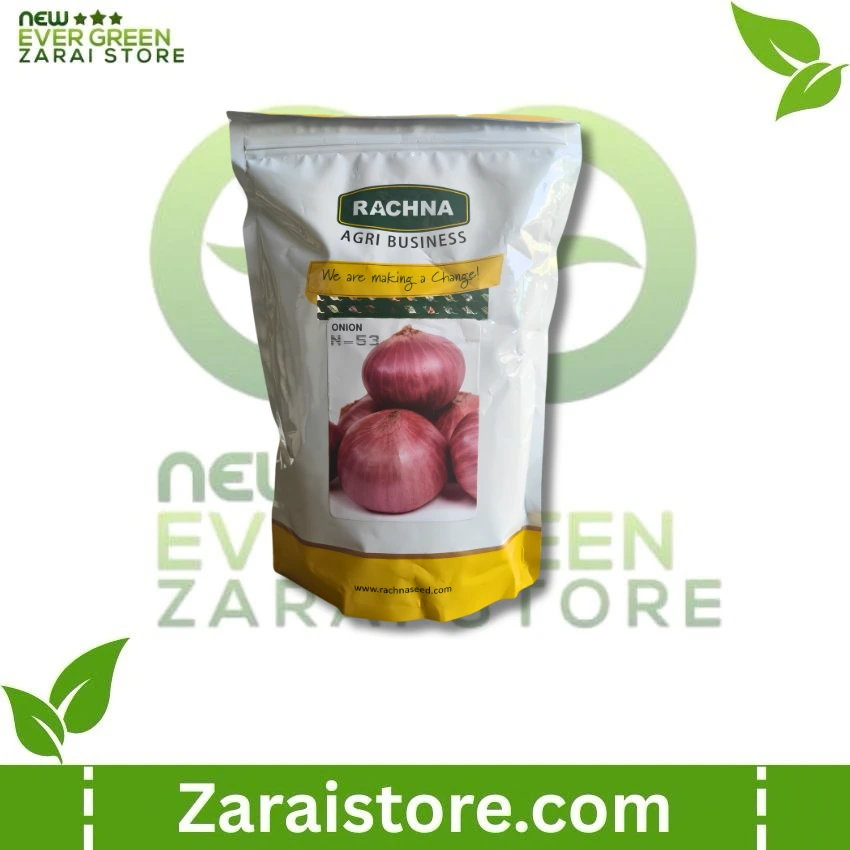 Rachna N-53 Onion Seeds 1kg Pyaz Beej Pakistan
Join our exclusive subscriber community and unlock special discounts. Don't miss out on the savings - subscribe today!
Experience our lightning-fast delivery service within 3 to 7 days.
Customer satisfaction is our priority. If you're not satisfied return it within 7 days.
Support team is here for you 24/7. Whether you have a question or require any support.
Your transactions are safe and secure with us. We offer trusted and encrypted payment options.
Enjoy Free & Fast Delivery All Pakistan 45 Days Free Returns